

Land Mapping Software for Solar & Renewable Energy Site Selection
Latapult’s GIS mapping software helps solar and other renewable energy developers make confident, cost-effective land decisions. In a market where every dollar counts, the platform provides clarity to complex land data, allowing you to focus on high-potential sites and move forward with confidence. As a land intelligence platform, Latapult supports renewable teams from the first site search through development.

Make Faster, Smarter Decisions
Maximize Every Dollar of Your Budget
Latapult helps solar and renewable energy teams evaluate land with greater speed, accuracy, and confidence.

Stop Wasting Time on Scattered Data
Get nationwide land and parcel data in one place, with built-in layers for topography, zoning, floodplains, wetlands, and more.

Find Sites That Actually Pencil Out
Evaluate properties based on solar-specific criteria like transmission lines, substations, acreage, and buildable area.

Cut Due Diligence Costs
Identify red flags early to avoid wasted spend and keep project budgets on track.

Make Decisions You Can Defend
Visualize and compare shortlisted sites side by side to make clear, data-backed decisions.

Share Insights, Not Spreadsheets
Collaborate with internal teams and stakeholders using built-in tools and intuitive visuals.

Get Data Others Leave Out
See the complete picture without cherry-picked data layers or confusing workarounds. What you see is what you get—and what you need.
Find the Right Site. Avoid the Wrong Spend.
Latapult doesn’t just present data. It structures and interprets complex U.S. land information through purpose-built tools that reveal what matters most to solar and renewable energy development.
- Search land near substations and transmission lines
- Evaluate buildable acreage, slope, wetlands, and flood zones in one view
- Determine surface access and terrain issues before they impact
development
- Filter by solar-relevant attributes to prioritize viable sites
- Generate visual outputs to support planning, collaboration, and buy-in
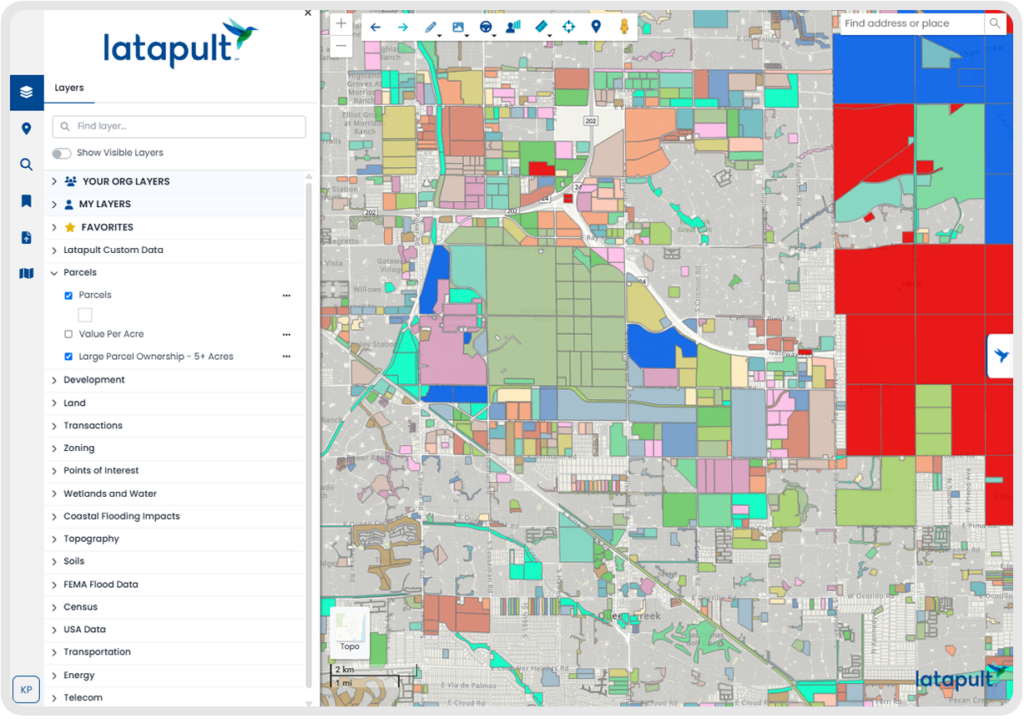
GIS Data That Keeps Every Variable Visible
You don’t need more data—you need the right data. Latapult brings together the land, utility, and environmental layers that matter most to solar and renewable energy development, including:
- Parcel and Transaction Data – Review ownership, acreage, and sales history to surface viable opportunities
- Energy and Utility Data – Map substations, transmission lines, and service areas to guide siting decisions
- Wetlands and Water Data – Flag environmental barriers before they slow down your timeline
- Topography Data – Understand slope and elevation to assess buildability at a glance
- Economic Development Zones – Spot Opportunity Zones and qualified tracts to boost project ROI
- Transportation and Access Data – Check proximity to roads, rails, and traffic patterns for logistical planning
Rather than tracking down available property data and sifting through multiple sources to find out if prospective land checks all the boxes for a renewable energy development, clients can search, manage, and evaluate land data in Latapult based on exact criteria.
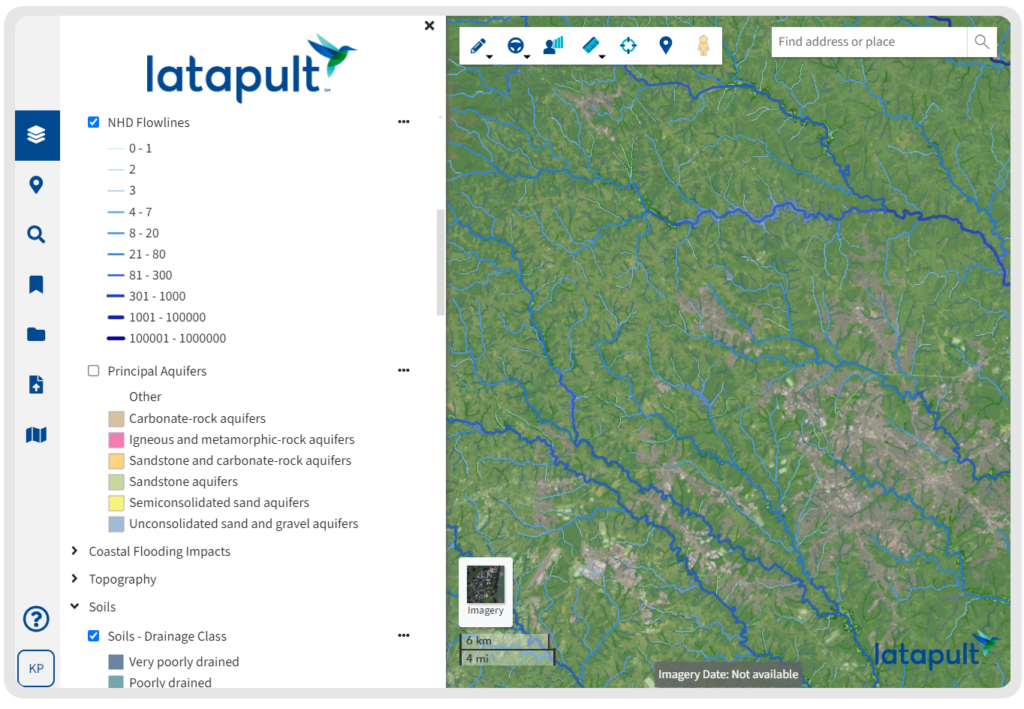
GIS Built For Renewable Energy Site Discovery
Latapult makes it easy to evaluate, compare, and share potential solar and renewable energy sites—all in one place.
- Drop pins to mark and annotate properties with renewable energy potential
- Apply the Buildable Area Tool to quickly calculate usable acreage
- Use bookmarks to track and compare high-priority sites
- Export maps to share with internal teams and project partners
- Import external site plans and overlays for added context
- Filter for specific traits to surface promising zones early
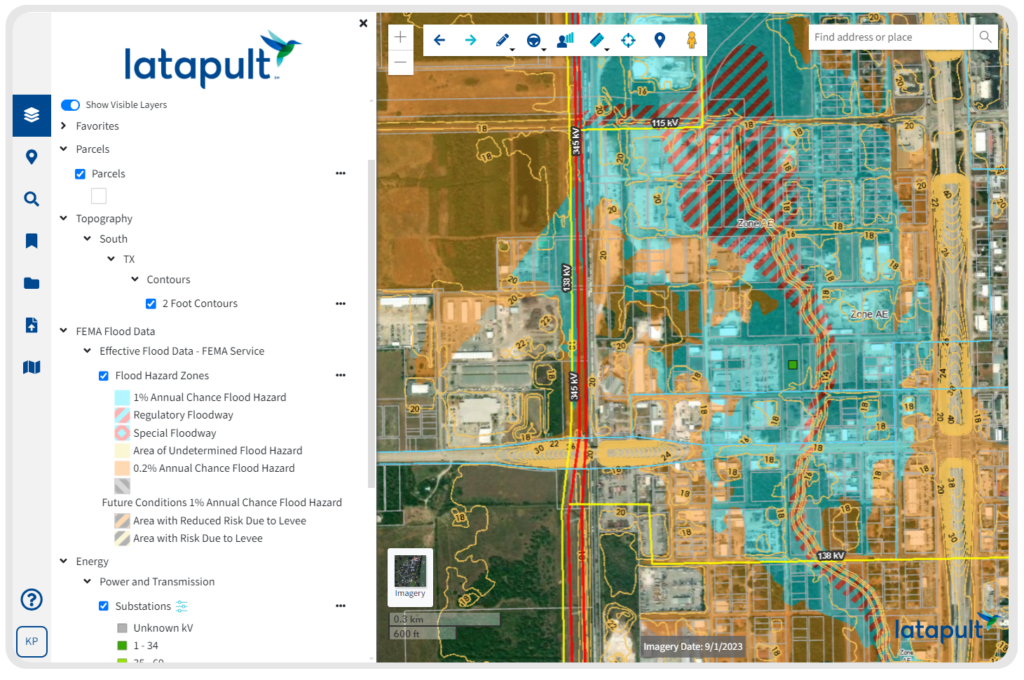
Tailored to Solar & Renewable Energy Siting
Latapult is built to support most solar and renewable energy teams right out of the gate. But when projects need something more specific, our team can help customize the platform to better fit your workflow.
- Connect with internal systems like CRMs or databases
- Import and visualize custom attribute-level datasets
- Build workflow tools that match your internal process
- Extend features to support long-term project tracking
- Get guidance from GIS experts who understand your goals
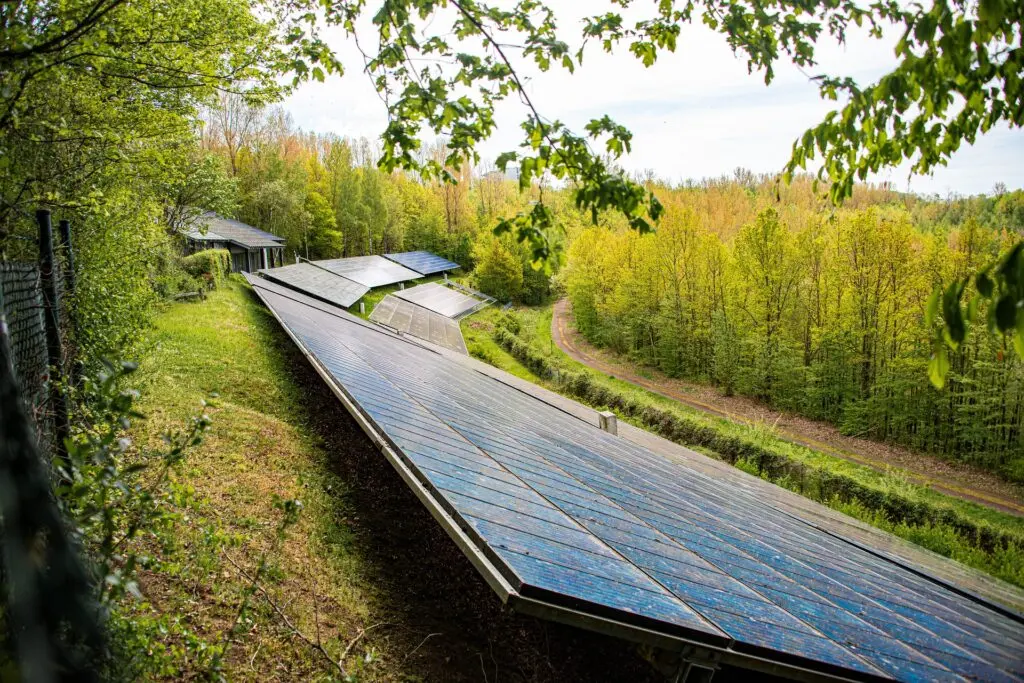
Register for a quick discovery call with Latapult!
Book a discovery call with Latapult to discuss your business and land challenges, explore recommended features and find out how Latapult can best align with your needs.






Frequently Asked Questions
-
How do renewable developers use GIS to screen environmental constraints?
GIS helps assess the potential environmental impact of renewable energy projects by layering data, including wetlands, flood zones, topography, protected areas, and wildlife habitats. By visualizing and analyzing this data early in the planning process, developers can identify risks, avoid sensitive zones, and streamline permitting.
-
What criteria do solar developers use to screen sites?
Most teams start with contiguous acreage, slope (often under 5% for ground-mount solar), distance to substations and transmission lines, wetlands, flood zones, and road access, then check ownership. Latapult lets developers apply these criteria in smart land searches and save the results, so origination teams work from the same shortlist.
-
What should renewable developers look for in GIS mapping software?
Look for energy infrastructure layers (substations, transmission lines, service areas) next to parcel ownership, tools that calculate buildable acreage, searches that filter land by your criteria, and a way to share sites across land, development, and GIS teams. Data freshness matters too: Latapult’s data is updated monthly, quarterly, or yearly depending on the source, and teams can import their own data.
-
How do you find land near substations and transmission lines?
Run a proximity search from substations or transmission lines, then filter the results by acreage, slope, and ownership. Latapult maps substations, transmission lines, and utility service areas next to parcel data, so teams can see which tracts sit within a set distance of grid infrastructure before contacting landowners with Latapult’s land acquisition software.
-
Can Latapult show interconnection queue or hosting capacity data?
Interconnection queues are published by grid operators such as PJM, MISO, and ERCOT, and hosting capacity maps by individual utilities. Teams can import that data into Latapult as a layer and view it with substations, transmission lines, and parcels. Utility teams use the same infrastructure layers through Latapult’s utility mapping software.
-
How do solar developers calculate buildable acreage on a parcel?
Start with the parcel boundary, then remove wetlands, flood zones, steep slopes, and required setbacks. Latapult’s Buildable Area Tool does this on the map and reports usable acreage, so teams can check whether a tract supports the planned project size before paying for engineering. Developers continue that work in Latapult’s software for land development.
-
Does Latapult support wind and battery storage projects?
Yes. Wind and storage teams use the same parcel, transmission, substation, topography, and environmental layers as solar teams, along with wind data. Storage projects need less land but the same grid access, so proximity searches from substations are usually the first step.
